Maruti Furniture Job Card ERP
A multi-tenant, role-based real-time production tracking and ERP system designed for high-scale furniture manufacturers.
Mon Apr 20 2026
React
TypeScript
Node.js
MongoDB
Socket.io
Tailwind CSS
Puppeteer
GCP Cloud Run
WhatsApp API
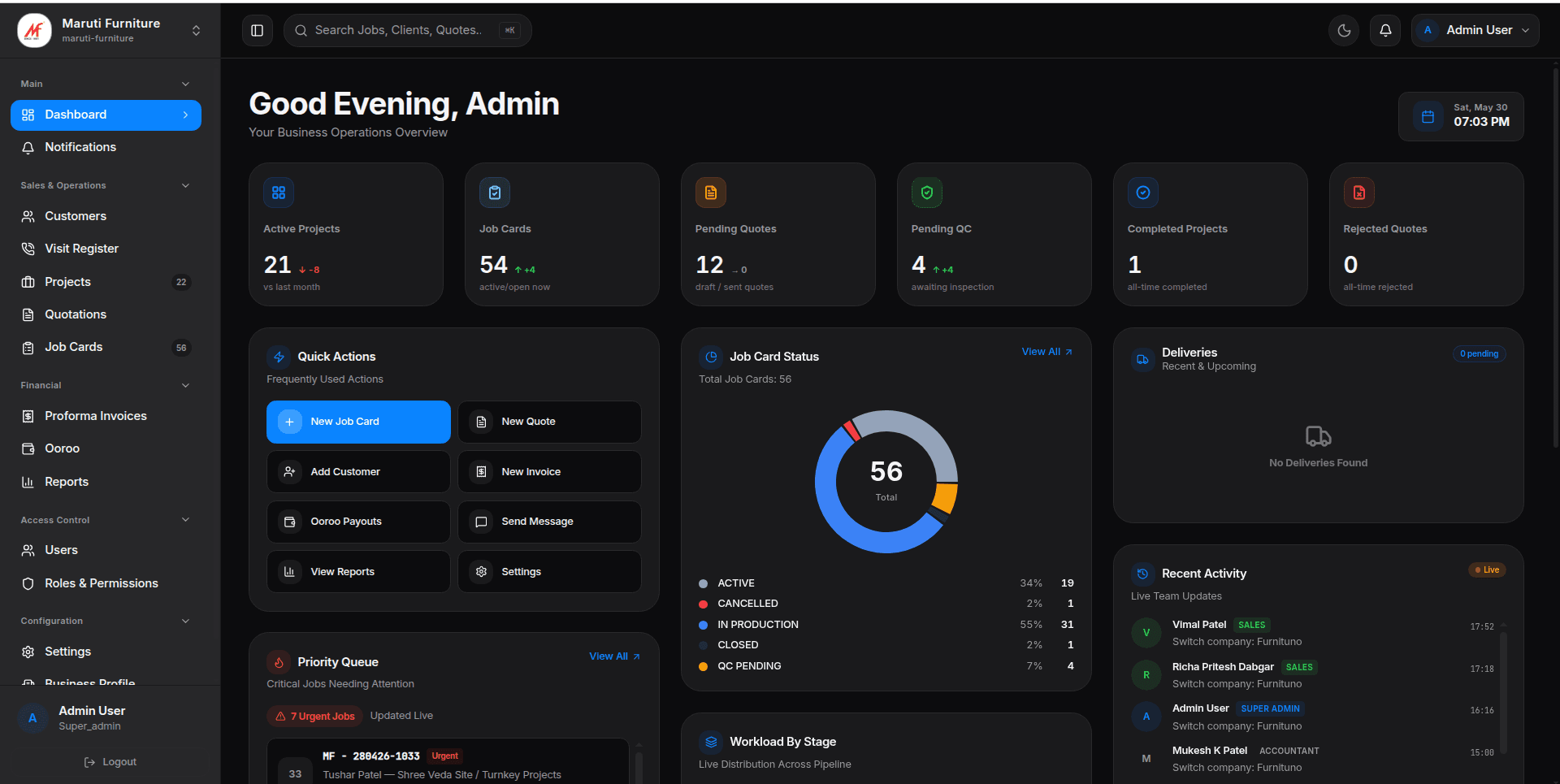
The Maruti Furniture Job Card system is a multi-tenant, multi-role, real-time order-to-delivery tracking ERP built for modern furniture manufacturers. It digitizes the entire production lifecycle, replacing manual paperwork and fragmented communication with a single automated dashboard. Tracking every phase—from quotation creation to automated design sign-offs, inventory management, production floor stages, quality control, dispatch, and final GST invoicing—the application ensures flawless operational efficiency with zero data leakage across companies.
Features
- Multi-Tenant Architecture: Supports multiple distinct company brand contexts within a single deployment, utilizing secure database scoping to ensure zero cross-company data leakage.
- Dynamic Permission Engine: A highly granular, role-based access control system featuring dynamic user permission overrides (grants/denies) with full audit logging.
- Real-Time Stage Tracking: Interactive live progress tracking of job card items flowing across 9 major company stages (Quotation, Project, Job Card, Design, Store, Production, QC, Dispatch, Billing).
- Automated WhatsApp Integrations: Instant WhatsApp notifications dispatched to client direct lines and internal staff groups for real-time status updates and order milestones.
- Automated PDF Engine: On-the-fly, high-fidelity PDF rendering via Puppeteer for quotations, job cards, QC certificates, delivery challans, and GST-compliant invoices.
- Inventory & Purchase Orders: Built-in inventory tracking that automatically checks materials against Bill of Materials (BOM) specifications, flagging low stock and streamlining purchase orders.
Tech Stack
- Frontend: Designed with React 19, Vite, and TypeScript for an ultra-responsive UI, styled beautifully with Tailwind CSS v4 and Radix UI primitives.
- State & Data Fetching: Powered by Zustand for lightweight state management and TanStack React Query for efficient, cached server-state synchronization.
- Backend: Built on Node.js and Express, implementing a secure JWT and cookie-based authentication architecture.
- Database: MongoDB with Mongoose for resilient, scoped document relations and transactional sequences.
- Real-Time Communication: Integrates Socket.io for live dashboard updates and state sync across devices.
- Cloud & DevOps: Deployed globally using Docker containers on GCP Cloud Run (backend) and Google Cloud Storage (GCS) fronted by a GCP Load Balancer with CDN (frontend).
Implementation
Frontend
- Developed dynamic, mobile-first dashboard interfaces optimized for production floor workers using React and Radix UI components.
- Seamless state caching and synchronization using TanStack React Query, coupled with real-time Socket.io socket feeds for live updates.
- Styling implemented via Tailwind CSS v4 and custom micro-animations for high-fidelity interactive elements.
Backend & Integrations
- Engineered an Express API utilizing robust middleware chains for JWT authentication, company context scoping, and granular dynamic permission checks.
- Developed an automated WhatsApp BSP integration to automatically dispatch template-based updates at critical stages.
- Deployed a Puppeteer engine in Docker containers to generate beautifully structured business PDFs from EJS templates.
Cloud Deployment
- Implemented a resilient CI/CD pipeline building Docker images for Cloud Run with Secure Secret Manager integration.
- Optimized frontend assets on GCS with fine-grained Cache-Control headers and automatic global CDN invalidations to guarantee instant updates with no client downtime.
How It Works
- Quotation & Client Onboarding: Sales agents enter client details (with integrated GSTIN auto-verification) and create a rich items list to compile an immediate PDF quote sent directly via WhatsApp.
- Project & Job Card Conversion: Approved quotations are converted into active Projects with dedicated, automatically logged WhatsApp groups. Admin splits work into targeted, trackable Job Cards.
- Design & Client Approval: The design team uploads CAD files and measurements. A secure, one-time public link is sent to the client for immediate, login-free digital design approval.
- BOM & Store Issue: The store checks the Design BOM against real-time inventory, issuing materials or raising automated purchase orders for missing components.
- Multi-Stage Production & QC: Workshop employees update the job card through 8 distinct sub-stages (Cutting, Edge Banding, CNC Drilling, etc.) on mobile dashboards. Quality Control evaluates the finished product against checklists, either issuing a QC certificate or initiating structured reworks.
- Dispatch & GST Billing: Dispatch schedules delivery teams, generating a delivery challan and capturing digital signatures/photo proof upon delivery. The accounting team records payments and generates GST invoices directly from the project history.
Challenges Faced
- Complex Permission Matrix: Resolving cumulative role defaults alongside temporary and permanent granular user permission overrides required a meticulously optimized lookup and cache validation logic.
- Puppeteer Performance in Docker: Configuring chromium dependencies and rendering custom fonts inside a low-resource Docker container for Cloud Run required rigorous optimization of EJS layouts and memory allocations.
- High-Fidelity Real-Time Sync: Maintaining instant UI responsiveness and concurrent socket streams for on-floor workers in low-connectivity areas without crashing state caches.
Future Enhancements
- Offline-First Synchronization: Introducing service workers and IndexedDB storage to support seamless offline actions on the workshop floor during connectivity drops.
- Advanced Manufacturing Analytics: Developing predictive analysis panels utilizing ML models to forecast bottleneck stages and optimize delivery timelines.
- Barcode & QR Scanner Integration: Embedding native camera scanner interfaces to allow workshop technicians to update stage statuses by scanning physical tags on production units.